The Invisible Grammar of Dress: How Fashion Encodes Who We Are
Long before a word is spoken, clothes have already delivered their verdict. The garment you choose each morning is not merely a practical response to weather or social convention; it is a text, dense with implication, legible to anyone who has absorbed the visual grammar of a culture. Fashion semiotics — the study of how clothing generates meaning — reveals that dressing is never neutral, however fervently the person in a plain white shirt might insist otherwise.
The mechanisms through which clothing signifies are more intricate than they first appear. A garment carries at least three simultaneous layers of meaning: its denotative function (it covers and warms), its connotative charge (a tailored lapel reads as authoritative, a deconstructed hem as avant-garde), and its indexical quality — the way it points beyond itself to a specific subculture, historical moment, or economic position. When a banker unbuttons his collar on a Friday afternoon, he is not simply loosening fabric; he is performing a calculated modulation of identity, signalling accessibility without surrendering the authority encoded in the suit itself. The gesture is both intimate and entirely legible to those around him.
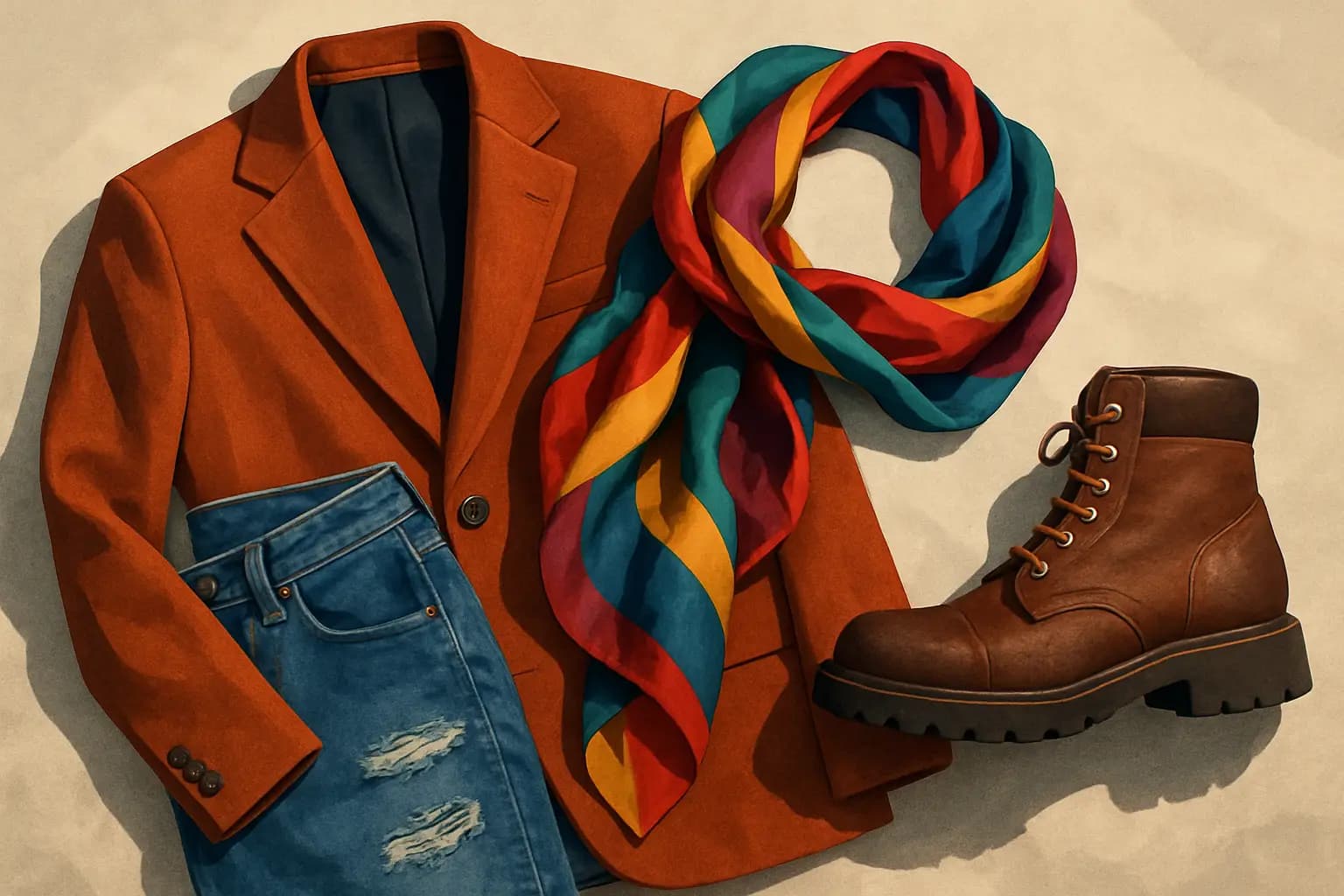
What makes fashion particularly compelling as a semiotic system is its capacity for irony. Meaning does not reside stably in any single garment; it is perpetually renegotiated through context and recontextualisation. The heavy work boot that once indexed manual labour and economic hardship was conscripted into high fashion in the nineteen-nineties and has oscillated between authenticity and ironic citation ever since. Luxury brands routinely quarry the aesthetics of poverty or rebellion — the deliberately distressed denim, the oversized puffer lifted wholesale from urban streetwear — and in doing so they both honour and hollow out the original meaning. This is the productive tension at fashion's core: signs that migrate across class boundaries acquire new resonances while shedding old ones, and the resulting ambiguity is not a failure of communication but precisely its point.
Gender is perhaps the axis along which fashion's semiotic power is most persistently contested. Clothing has historically enforced binary categories with remarkable rigidity — the trouser as masculine prerogative, the skirt as feminine constraint — yet every generation produces figures who exploit the instability of these codes. When Marlene Dietrich appeared in a tuxedo in the nineteen-thirties or when the fashion houses of the twenty-first century sent male models down the runway in skirts, the disruption was not merely aesthetic. It was argumentative: a claim, encoded in cloth, about the arbitrariness of the conventions it was violating. Fashion here functions as a form of speech that bypasses language and strikes directly at the nervous system of social assumption.