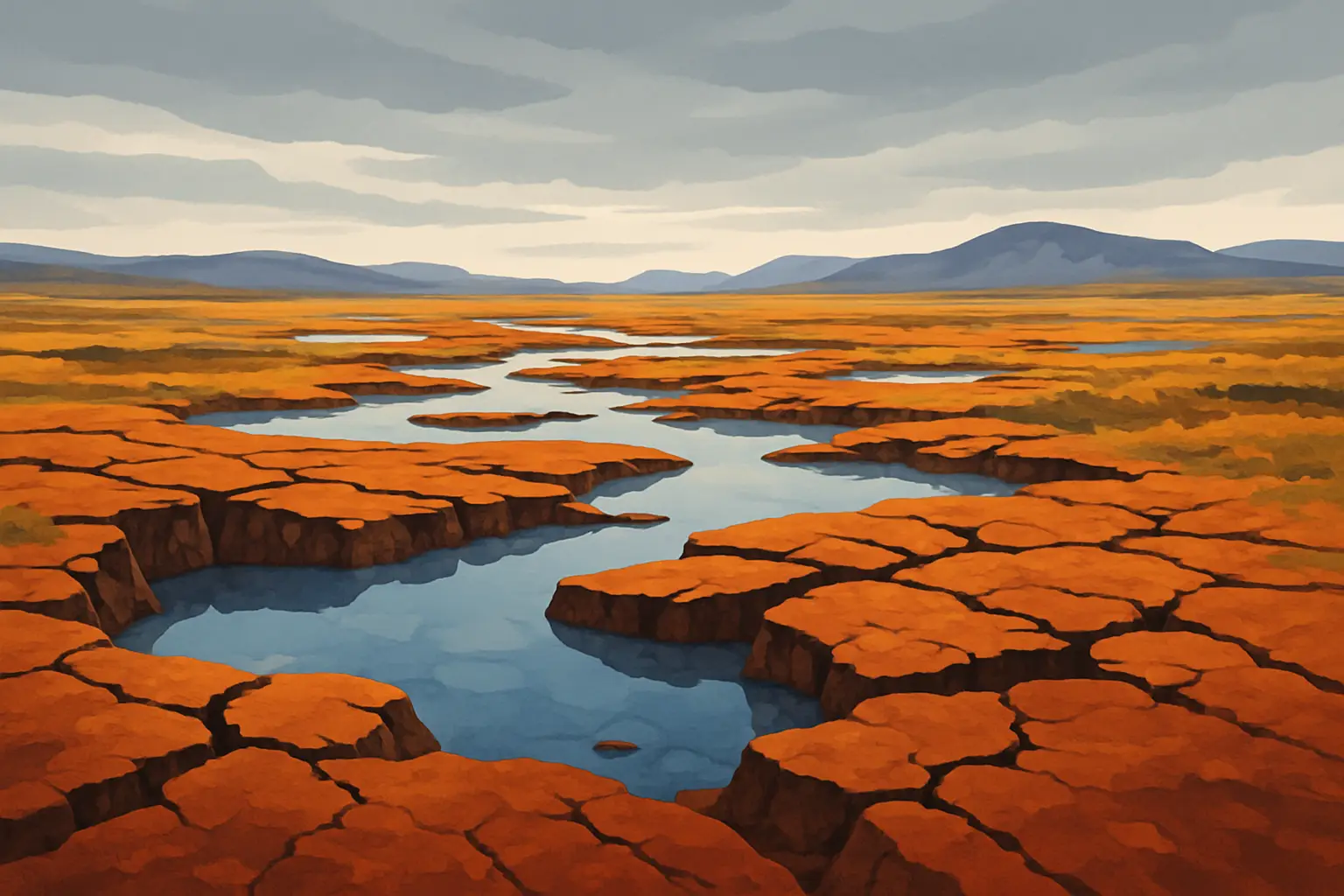
The Slow Violence of Melting Permafrost
There is a category of environmental disaster that never makes the front page — not because it lacks consequence, but because it unfolds too gradually for the news cycle to accommodate. The thawing of permafrost belongs squarely in this category: a process so vast, so incremental, and so laden with long-term consequence that most people remain entirely unaware it is happening at all, let alone that it may represent one of the most significant feedback loops in the entire climate system.
Permafrost is ground that has remained frozen for at least two consecutive years, though in practice much of it has been locked solid for tens of thousands of years. It underlies roughly a quarter of the Northern Hemisphere's land surface, stretching across Siberia, northern Canada, Alaska, and parts of Scandinavia. Crucially, this frozen ground acts as a vast carbon vault. Millennia of dead plant and animal matter were buried and preserved before they could fully decompose, trapping enormous quantities of carbon dioxide and methane in a kind of geological cold storage. Current estimates suggest that permafrost soils hold nearly twice as much carbon as is currently present in the Earth's atmosphere — a figure that ought to command far more public attention than it does.
As global temperatures rise, that vault is beginning to open. Warming causes the active layer — the uppermost stratum of soil that thaws and refreezes each year — to deepen, while the permafrost beneath it retreats. Microbes that were effectively dormant in frozen soil suddenly spring to life and begin decomposing the organic material that has been preserved for millennia. In doing so, they release carbon dioxide and, under waterlogged anaerobic conditions, methane — a greenhouse gas with roughly eighty times the short-term warming potency of carbon dioxide. This released warmth accelerates further thawing in what scientists call a positive feedback loop: a self-reinforcing cycle that, once fully triggered, may prove extraordinarily difficult to interrupt regardless of how swiftly humanity curtails its own emissions.